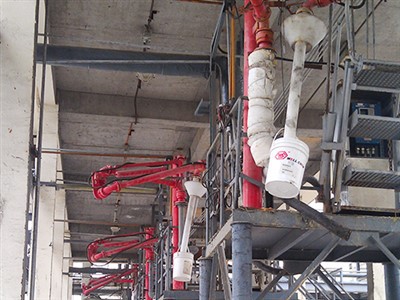
Products Description
The structure of a mixed system is more complex than a single-mode system, primarily reflected in manifold distribution and terminal execution mechanisms.
Operational Workflow
Scenario 1: Top Loading Mode
Mode Switching: Confirm the switch to "Top Loading" status on the control panel or field valve manifold (top loading line active).
Vehicle Positioning: The tanker docks and connects the static grounding cable.
Manual Operation: Open the tanker's top manhole cover, insert the loading arm to the submerged position, and install the overfill probe.
Start Loading: The system detects proper grounding and probe placement, then opens the valve to start loading.
Completion: Upon reaching the preset quantity, the valve closes, the pump stops, the arm is retracted, and the cover is closed.
Scenario 2: Bottom Loading Mode
Mode Switching: Confirm the switch to "Bottom Loading" status (bottom loading line active, vapor recovery line open).
Vehicle Positioning: The tanker docks and connects the static grounding cable.
Connection:
Connect the bottom loading coupler to the tanker's API socket.
Connect the vapor recovery arm to the tanker's top vapor port.
Start Loading: The system detects the bottom connection and the insertion of the vapor port overfill probe, then opens the valve to start loading.
Completion: Upon reaching the preset quantity, the valve closes, the pump stops, residual liquid is drained, and connections are disconnected.
Working Principle
The working principle of the mixed system is based on "Flow Diverter Control" and "Mode Interlocking."
Physical Path Selection:
1. Top Loading Mode: The system opens the top-loading branch valve and closes the bottom-loading branch valve. Material is injected via the loading arm from the top.
2. Bottom Loading Mode: The system opens the bottom-loading branch valve and closes the top-loading branch valve. Material is injected via the bottom coupling, while the vapor line connects to the recovery system.
3. Vapor-Liquid Balance Principle (Bottom Loading):
In bottom loading mode, as liquid enters from the bottom, it displaces the volume inside the tank. The vapors are pushed out through the top vapor recovery arm, returning to the storage tank or processing unit to achieve a closed-loop cycle.
4. Safety Logic Determination:
The control system activates different sensors based on the selected mode. For instance, in bottom loading mode, the system focuses on monitoring the overfill sensor signal at the vapor port; in top loading mode, it monitors the probe signal inserted into the manhole.
Why Choose a The Top & Bottom Loading Mixed Skid System
Ideal for Transition Periods
Perfect for factories transitioning from "open loading" to "closed loading." It allows you to accommodate new trucks without needing to eliminate old ones immediately.
Multi-Product Compatibility
Certain special materials (like high-viscosity asphalt or foaming liquids) may be better suited for top loading, while standard refined oils suit bottom loading. One system handles all materials.
High Space Utilization
Achieves dual functionality with a single skid-mounted device on a limited loading island, saving on civil engineering investment.
Product Application


Certificates


Products Description


Hot Tags: Top and Bottom Loading Skid, China, suppliers, manufacturers, factory, customized, price, quotation, in stock, automatic bathing system controller, low temperature swivel joint, loading arm with dry break coupler, Swivel Joints for Loading Arms, Portable gangway folding stair for oil tank platform, carbon steel rotary joint